Rigid box construction: grayboard weight, wrap paper, lid fit and corner types
A rigid box is built in two stages. First, thick grayboard, usually 1200 gsm and about 0.08 inch thick, like a hardcover book cover, is cut and scored into the lid and base shells. Then a sheet of printed wrap paper is glued over the outside and folded around the edges. The result is a box that does not collapse, does not need assembly and does not lose its shape. That construction is what separates a rigid box from a folding carton and is why it costs more to make.
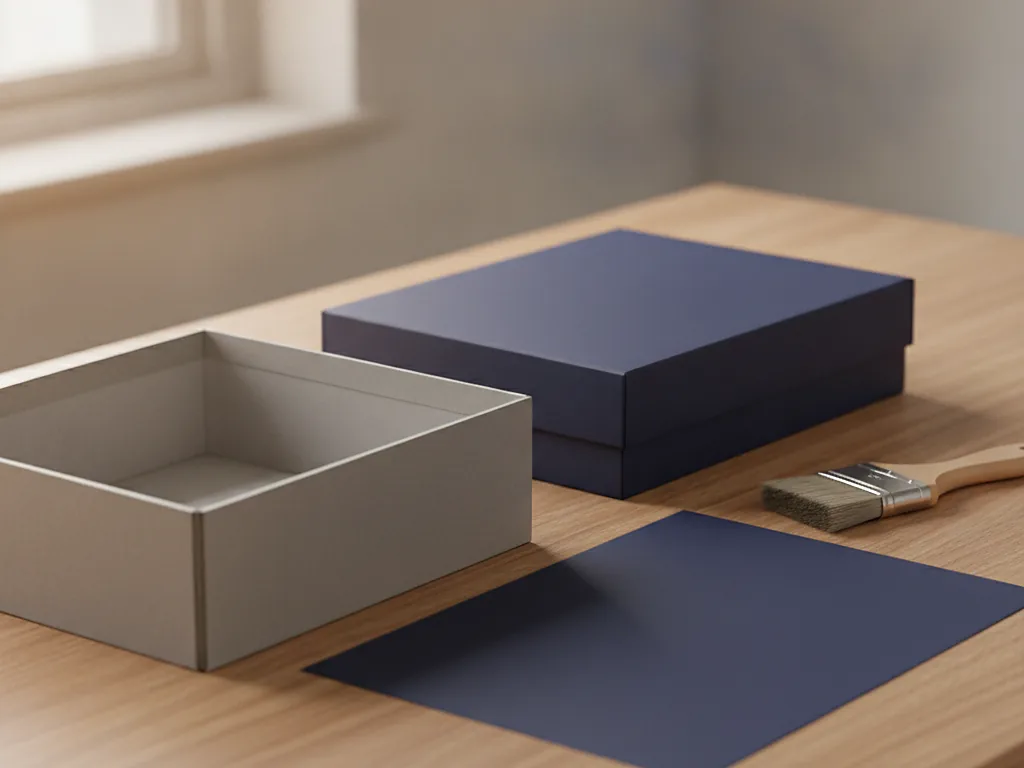
Grayboard: the structural core
Grayboard is a dense, stiff recycled paperboard, the same kind of board used in hardcover book covers. It is specified by weight in grams per square meter, gsm, and a higher number means a thicker, stiffer board. We build rigid boxes on three weights.
| Grayboard | Feel | Where we use it |
|---|---|---|
| 1000 gsm | Light and crisp at small sizes | Jewelry boxes, ring boxes and other small boxes |
| 1200 gsm, about 0.08 in | The standard; substantial without being heavy | Most magnetic, drawer, book-style and two-piece boxes |
| 1500 gsm | Heavier, stays flat across long panels | Large boxes, the base and lid of a shoulder box, heavier gift sets |
Board thickness adds to the outside. With 1200 gsm walls and the wrap, a box is roughly 0.2 inch bigger outside than inside on each dimension. That outside size is what the shipping carton and the carrier rate are based on, so quote both if freight matters.
Wrap paper
Wrap paper is the printed skin that covers the grayboard. It is printed as a flat sheet, then bonded over the board and folded cleanly at the corners. The wrap paper choice controls what the box looks like, how it feels and what finishing options are available.
Coated art paper. A smooth, clay-coated sheet that takes full-color offset printing accurately and cleanly. It is the most common wrap paper and takes soft-touch, matte or gloss lamination. This is the right choice whenever CMYK photography, gradient fills or complex branding is part of the design.
Linen texture paper. A paper with a fine woven texture pressed into the surface. It accepts print but the texture softens fine-line detail. Brands use it for a premium look that does not rely on heavy ink coverage. Embossing or blind deboss holds particularly well on linen wrap.
Kraft wrap. An uncoated natural kraft surface. Prints in one to three colors with a visible texture in the ink. Popular for sustainable-positioned brands and products that want an earthy aesthetic alongside rigid construction.
What we do not stock. Leatherette, bookbinding cloth and metallized wrap papers are not part of our range. For a metallic effect, foil on a matte or linen wrap does the job, and for a soft feel, soft-touch lamination.
Corner construction
At each corner, the wrap paper has to fold around the grayboard neatly. How that fold is executed determines the corner finish.
Turned-in corner. The standard method. The paper is cut at a 45-degree notch at each corner, and the excess is folded inside the box wall. The result is a clean squared corner on the outside and a neat mitered fold on the inside edge of the wall. This is what most rigid boxes use.
Book corner. A variant where the paper overlaps rather than miters. The visible result is a slightly softer corner with a layer of paper over the edge. More durable under rough handling and common in travel packaging and cases that get jostled.
Exposed grayboard edge. Some designs intentionally leave the grayboard visible at the lid opening edge: a thin gray or brown line between the outer wrap and the inner lining. This is a manufacturing simplicity choice and is usually hidden with a printed or foiled inner lining in higher-end work.
Lid fit
The lid is sized so it sits over the base with a controlled gap. That gap, called the lid fit tolerance, is set at the dieline stage and affects how the box opens and how secure it feels closed.
A loose fit, about 1/16 inch per side, opens with almost no resistance and is preferred for boxes the customer opens repeatedly or ships to elderly customers. A snug fit, closer to 1/32 inch per side, requires a deliberate pull and feels sealed. For gift boxes and luxury goods where the opening moment is intentional, snug fits are the norm.
A magnetic closure box changes the calculation: the magnet provides the holding force, so the physical fit can be slightly looser than a snug friction-only lid, which makes the magnet feel more decisive when it pulls the lid down.
Inner lining
The inside of the box is lined separately. The most common lining is a smooth coated paper, printed in one to two colors or solid black. More elaborate interiors use velvet flocking on the insert or the inside of the lid. The lining paper is glued to the four walls and the base in a separate operation after the outer wrap is applied.
The inner lining hides the raw grayboard edge and gives the unboxing experience its visual floor. A white interior makes the product pop. A black interior makes the same product look more dramatic. A branded pattern or a tactile texture makes the moment memorable.
Questions people ask
What grayboard weight should I choose?
For most retail rigid boxes, 1200gsm is the right starting point. It gives a box that feels substantial without being heavy, holds its shape under normal retail handling, and takes wrap paper cleanly. Small boxes such as jewelry and ring boxes use 1000 gsm to keep proportions from looking thick. Larger boxes for watches, shoes or gift sets step up to 1500 gsm to prevent flex across the longer panel. The Tria team will recommend the right weight based on your size and product weight.
What is lid fit tolerance and how tight should my lid be?
Lid fit tolerance is the difference between the inner dimension of the lid and the outer dimension of the base. A looser fit, about 1/16 inch per side, opens easily and is good for boxes the customer opens frequently or mails to recipients who may struggle with a tight lid. A snug fit, closer to 1/32 inch per side, opens with a deliberate pull and stays firmly closed in transit. For gift boxes and products that need to feel sealed and premium, a snug fit is usually preferred. For boxes with magnetic closures, the magnet handles the closing force and the physical fit can be looser.
What is the difference between a set-up box and a collapsible rigid box?
A set-up box, also called a traditional rigid box, is glued into its final shape at the factory and ships assembled. It takes up more space but is ready to fill the moment it arrives. A collapsible rigid box uses scored and hinged grayboard so the box folds flat for shipping and storage, then pops into a rigid shape before packing. Our collapsible rigid box takes about a tenth of the storage space flat, which matters when storage space is limited. The assembled rigidity is slightly less than a traditional set-up box, but for most products it is indistinguishable by feel.
Can I add a magnetic closure to any rigid box style?
Magnetic closures can be added to most rigid box styles where the lid and the base make full contact across a panel edge (a shoulder box, a book-style box, a standard two-piece lid) but they work best when the lid and base walls are parallel and meet at a consistent gap. The magnets are seated inside the grayboard during construction, not glued to the surface. A magnetic closure adds cost and cannot be added after a non-magnetic box is built. Specify it at the quoting stage.
What are my wrap paper options?
Wrap paper is the printed outer skin glued over the grayboard. The most common options are coated art paper, which takes CMYK offset printing and laminates like soft touch, matte or gloss; linen texture paper, which has a woven surface that gives an understated premium look with minimal print; kraft wrap, which prints in a limited palette but has a natural, earthy feel; and soft-touch lamination over art paper for the softest feel. We do not stock leatherette, cloth or metallized wraps. The choice of wrap paper affects which finishing options are available: soft touch lamination, for example, is only possible on coated art paper.