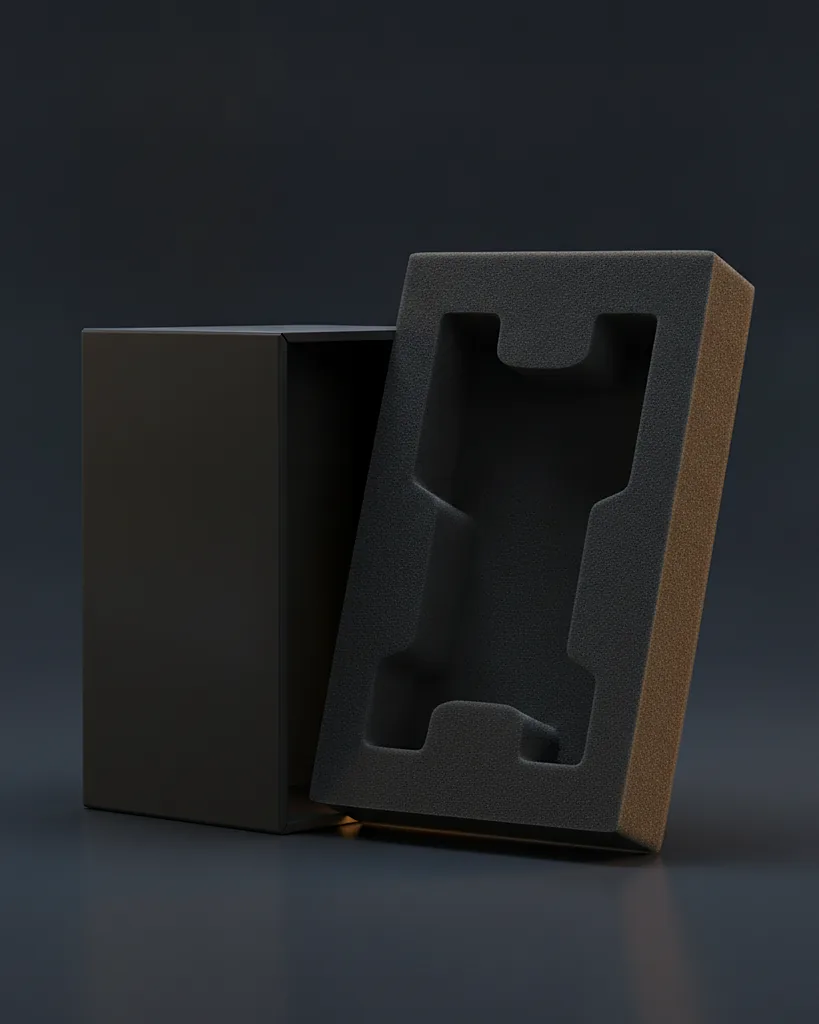
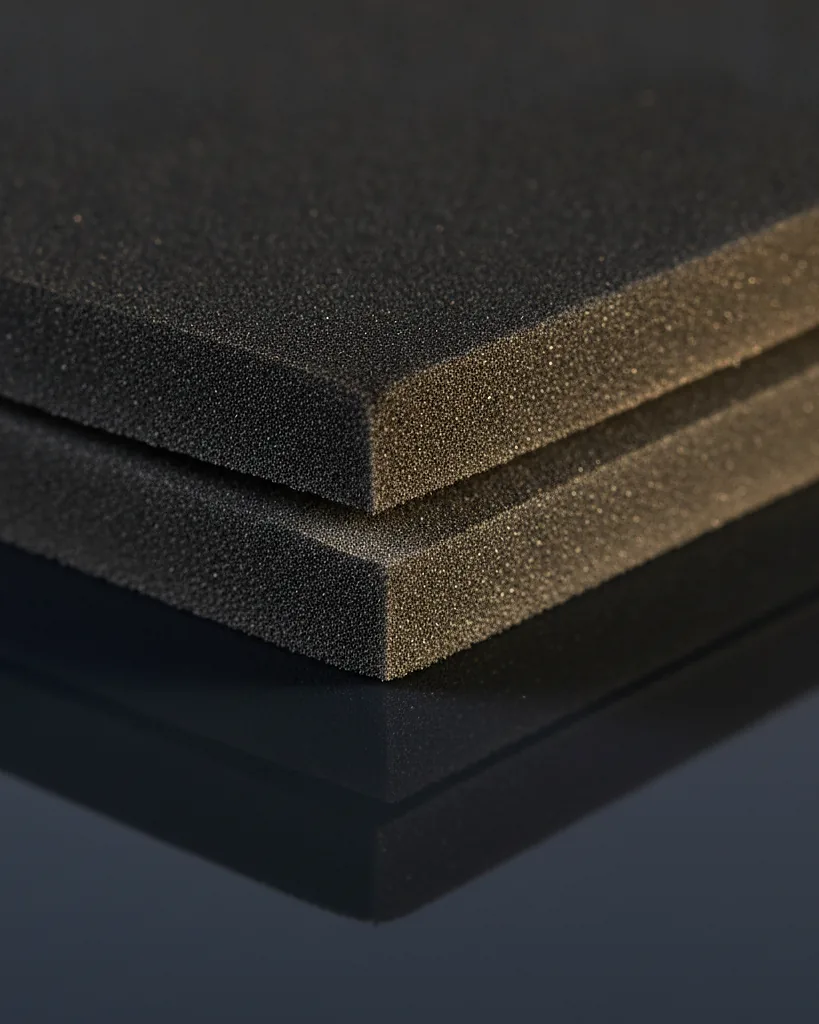
These are AI-generated illustrations of this style. Yours is made to your specification.
Custom foam inserts
EVA or PE foam200 minimum · 10 to 14 business daysA foam insert is a block of closed-cell EVA or PE foam die-cut with cavities that hold a product with no movement at all. They come from 3/8 to 2 3/8 in thick in black, white or gray, layered where a product has a shoulder, from 200 units in 10 to 14 business days after proof. Most are cut for boxes between 6 by 4 and 12 by 9 inches.
When to choose it, and when not to
Choose a foam insert when the product is glass, metal, electronic or expensive and a rattle is not acceptable. A fragrance bottle, a watch, a pair of earbuds and a cable, a set of knives. Foam holds a product at its exact outline, and black EVA against a printed box is the look most tech and spirits packaging uses. It also works when the box will be reopened many times, because foam does not crease or wear.
Choose a die-cut paperboard insert when the product is light and the insert should print or be recycled with the box, since foam does neither. Choose a molded pulp insert when the brand has a plastic commitment, because EVA and PE foam are plastics and go in general waste.
Specifications
| Board | EVA foam 2.4 to 2.8 lb per cubic foot, or PE foam about 1.9 lb per cubic foot |
|---|---|
| None on the foam, optional printed paperboard top sheet | |
| Finish | Black, white or gray, plain or velvet-flocked |
| Closure | None, friction fit in the box base |
| Insert | Single layer, or two to three layers glued for stepped cavities |
| Thickness | 3/8, 3/4, 1 1/8, 1 5/8 or 2 3/8 in, or a layered build to any depth |
| Minimum | 200 units |
| Lead time | 10 to 14 business days after proof |
| Ships | Placed in the box, or stacked flat in cartons of 25 |
| Common sizes | cut to fit a 6 x 4 x 2 in box cut to fit a 8 x 6 x 3 in box cut to fit a 10 x 8 x 4 in box cut to fit a 14 x 10 x 5 in box any size from 3 x 3 to 20 x 16 in footprint |
Foam inserts for vials and small bottles
Glass vials travel best when every vial has its own cavity, so glass never touches glass. We lay out one foam insert to hold the whole set, from a few sample vials to a few dozen small bottles of essential oil, fragrance or skincare.
To draw the layout we need four measurements: the vial diameter, the vial height with the cap on, how many vials go in each box, and the inside length, width and height of the box. The layout comes back on the dieline with your quote, usually within one business day of a complete brief, so you see exactly how many vials fit before anything is cut.
The box height decides whether vials stand. A standing vial sits in a cavity about two thirds of its height, on 3/8 in of solid foam, with a little room under the lid. If your vials are taller than the box allows, we suggest a box size that works. Need the box as well? We coordinate the box and the insert together through our partner manufacturers, and the box can be printed inside as well as outside; the foam itself is not printed.
Measuring vials for a foam insert
Measure one filled vial in inches. A ruler works; calipers are better for small diameters.
- Vial diameter at its widest point. If the cap is wider than the body, give the cap diameter too.
- Vial height with the cap on.
- How many vials go in each box.
- The inside length, width and height of the box, or tell us you need the box as well.
- How many inserts you need, from 200.
In the quote form, describe the vial under what you are packaging, enter its size in the size field and the number of inserts under how many. A photo of the vial helps.
For any other product
Send the product's length, width and height, a photo, how many pieces sit in one insert and the inside size of the box. If the product has a shoulder or a cap, give both heights, because that is where we use two glued layers with different cutouts.
Tell us EVA or PE, or let us suggest one. EVA holds a crisper cut edge for presentation. PE is softer and the lower cost choice for transit. Both are closed-cell.
Each cavity is cut to the outline of its item, so items sit in their own space and do not touch.
Velvet flocking adds about 3 business days, and EVA in colors other than black, white and gray adds about a week and carries a higher minimum. Need the box too? We coordinate both, for example a two piece rigid box or a rigid drawer box with the foam cut to fit.
Get a foam insert quoteMaterials that suit it
Questions people ask
EVA or PE foam?
EVA is denser, around 2.4 to 2.8 lb per cubic foot, holds a crisp cut edge and is what you see in watch and tech boxes. PE is softer, about 1.9 lb per cubic foot, and is the cheaper choice for protecting a product in transit where looks matter less. Both are closed-cell and do not absorb water.
How thick should the foam be?
The cavity should be about two thirds of the product's height so it lifts out easily. A 1 1/8 in foam holds a 1 3/4 in bottle well. Add 3/8 in of solid foam under the cavity as a floor. For a product with a shoulder or a cap, we spec two glued layers with different cutouts rather than one thick block.
Can the foam be a color?
Black, white and gray are stock and cover almost everything. Other colors are possible on EVA at a higher minimum and add about a week. A better route for color is a printed 18pt paperboard top sheet glued over the foam, which gives you full color and hides the foam edge.
Will foam mark the product?
Closed-cell EVA and PE are inert and do not off-gas or leave residue on glass, metal or lacquer. If the product is a polished chrome or a high-gloss lacquer that shows every touch, we recommend the velvet-flocked finish on the cavity, which adds a soft surface and about 3 business days.
Is foam recyclable?
No. EVA and PE foam go in general waste in almost every US program, and we do not print any recycling mark on them. If that matters to your brand, a molded pulp insert does most of what foam does for items under 3 pounds and is a paper fiber product, with recyclability confirmed on your quote. We will say which fits your product.
How is a foam insert different from a molded pulp insert?
Foam holds tighter and absorbs a harder hit. It is closed-cell EVA or PE foam, die cut with cavities, 3/8 to 2 3/8 inches thick, plain or velvet-flocked, and it is a plastic. The molded pulp insert is paper fiber pressed into your product's shape, with recycled content and recyclability confirmed on your quote, and an aluminum tool cut once and kept for reorders. Both start at 200 units in 10 to 14 business days after proof. Electronics and luxury glass suit foam; brands with a plastic commitment suit pulp.
Can one foam insert hold a whole set of vials?
Yes. One insert is cut with a separate cavity for every vial, so a full set travels in a single box without glass touching glass. Send the vial size, how many go in each box and the inside size of the box, and the layout comes back on the dieline with your quote, usually within one business day of a complete brief.
What do you need from me to quote a vial insert?
The vial diameter, the vial height with the cap on, the number of vials in each box, the inside length, width and height of the box, and your quantity. If the vial has a wider cap or shoulder, add that measurement too, and we spec two glued layers so each part sits in its own step. Foam inserts start at 200 units. Rush options, tooling and the print method for your quantity are confirmed on your quote.
Will my vials stand up in the box?
Only if the box is tall enough. A standing vial sits in a cavity about two thirds of its height, on 3/8 in of solid foam, so the inside height of the box has to be more than the vial height plus that 3/8 in floor, with a little room under the lid. If it is not, we suggest a box size that works and show it on the dieline before anything is cut.
Read next
Ready to price your foam insert?
Send the size and quantity for a quote and a dieline, usually within one business day. Your digital proof follows, usually within one business day of your artwork. Design help and the Swatch Book of materials are free.