How to measure a product for a custom box, with the clearance that fits
Measure the product at its widest points in inches, as it will be packed, including caps, labels and inner wrap. Add an eighth of an inch to each dimension for a snug carton, half an inch for a mailer with tissue, and three quarters where an insert holds it. Give us those as inside dimensions, length by width by height.
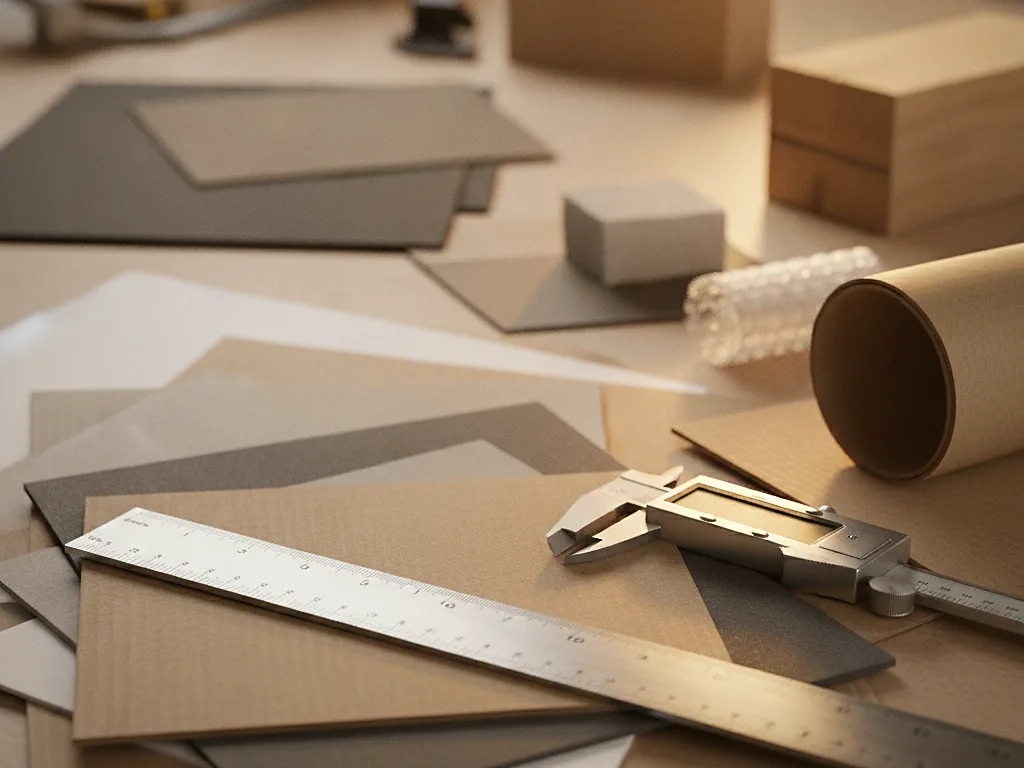
Measure the product as it ships, not as it looks
Lay the product on a flat surface and measure the three outside extremes: the longest point, the widest point and the tallest point. A jar with a lid that overhangs the body is measured at the lid. A bottle with a pump is measured with the pump on. A candle with a dust cover is measured with the cover. Round the result up to the nearest sixteenth of an inch. If two products go in one box, measure them together in the arrangement they will sit in, not one at a time.
Write the three numbers down as length by width by height, with length the longest horizontal side and height the vertical when the box is opened. It sounds fussy, but fit problems usually come from a jar measured without its lid or a set measured as if the items would stack when they will actually sit side by side.
The clearance rule
Clearance is the gap between the product and the inside wall. Too little and the product will not go in, or the board bows. Too much and it rattles. For a folding carton that holds one item snugly, add an eighth of an inch to each of the three dimensions on top of the product size, which gives a sixteenth per side. For a mailer with tissue or crinkle paper, add a quarter inch per side, so half an inch on each dimension. For a die-cut insert or cradle, allow three eighths per side so the insert has board to work with.
Board thickness is separate from clearance. We always quote inside dimensions, and we add the board on the outside. An 18pt carton adds about a sixteenth of an inch per wall. E-flute adds about a sixteenth as well. A 1200 gsm rigid box adds close to a tenth of an inch per wall, plus the wrap, so a rigid box is noticeably larger outside than in.
Clearance by box type
| Box type | Add per side | Add per dimension | Why |
|---|---|---|---|
| Folding carton, snug | 0.0625 in | 0.125 in | Slides in, does not bow |
| Folding carton with cradle | 0.375 in | 0.75 in | Board for the cradle |
| Mailer with tissue | 0.25 in | 0.5 in | Room to wrap and fold |
| Mailer with E-flute insert | 0.375 in | 0.75 in | Insert walls and cutouts |
| Rigid box with fitted insert | 0.5 in | 1 in | Insert depth and lift |
An illustrative example: one candle, two boxes
Illustrative spec, not a client order.
An 8 ounce candle in a straight-sided glass tumbler measures 3.25 inches across the lid and 3.5 inches tall with the lid on. The brand wants a kraft mailer with a simple E-flute cradle so it ships on its own. Add three eighths per side: 3.25 plus 0.75 is 4, and 3.5 plus 0.75 is 4.25. The inside dimension becomes 4 by 4 by 4.25 inches. We keep the quarter inch of headroom rather than rounding down to a 4 inch cube, because it stops the lid of the jar pressing on the tuck flap when the mailer is closed. Our candle shipper box goes further, with a two-collar cradle and a half inch floor gap, and puts the same jar in a 5 inch cube; that extra room is the protection.
For the shelf carton of the same candle, a candle box with no insert, the sums are 3.25 plus 0.125 and 3.5 plus 0.125, giving 3.375 by 3.375 by 3.625 inches. Two boxes, one product, two different sets of numbers, and both correct for what each box has to do. The carton holds the jar still on a shelf. The mailer holds it still through a courier, and that needs the cradle and the room for it.
Orientation and sets
Decide which way the product faces when the box is opened. A bottle in a carton stands upright, so the carton's height is the bottle's height. The same bottle in a mailer usually lies down, so the mailer's height is the bottle's diameter. Sets are measured as a footprint: lay the items out with a quarter inch between them, measure the outline, then measure the tallest item for height. Send us a photo of the arrangement from above and we will draw the insert to match it.
Our box size calculator does these sums for you and shows the outside size. If measuring is a chore, photograph the product beside a coin or a ruler on a plain surface and email that. We scale it, propose a size, and put it on the dieline for you to check before anything is cut. For anything in glass or anything heavier than about two pounds, the product itself is better than a photo. Ask us first and we will tell you where to send a sample.
Questions people ask
Do you quote inside or outside dimensions?
Inside, always. The inside is what your product has to fit, and outside dimensions vary with board. An 8 by 6 by 3 inch inside mailer on E-flute measures roughly 8.25 by 6.25 by 3.25 outside. Carriers measure the outside, so ask us for both numbers if you are checking a rate.
What if my product is not a box shape?
Measure the bounding box, the smallest rectangle it would sit inside, at its widest points. A round jar is measured by its diameter twice and its height once. An irregular item is best photographed from the front and from above beside a ruler so we can draw an insert around it.
How tight is too tight?
If you have to push the product in, the clearance is too small and the board will bow or the flap will not close. A snug carton should let the product slide in under its own weight and stay put when the carton is tipped. A physical prototype, available on request, is the way to check this before the full run.