Jewelry boxes: inserts, ribbon and the two sizes a jewelry line needs
A jewelry line usually needs two boxes: a square box around 3.5 by 3.5 by 1.5 inches for rings, earrings and pendants, and a long box around 7 by 3.5 by 1.25 inches for bracelets and necklaces laid flat. Both are rigid boxes on 1000 gsm board, 1200 gsm for larger or magnetic styles, with a velvet-flocked insert that holds the piece and stops it tangling.
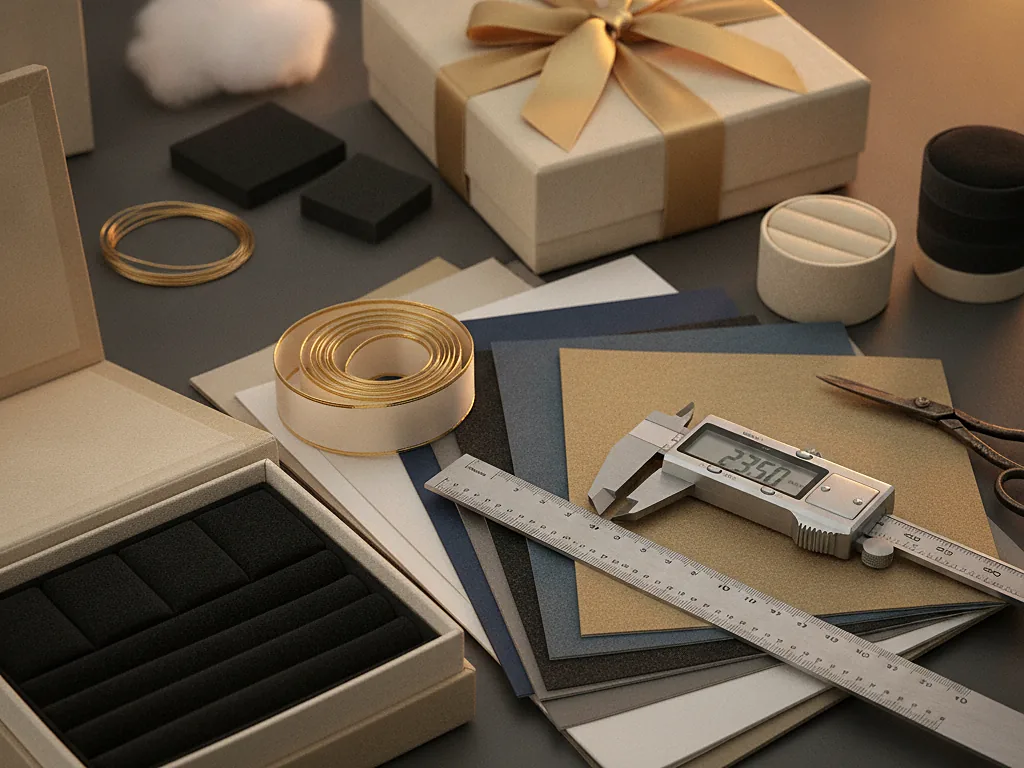
Why two sizes cover almost everything
A ring, a pair of studs, a pendant on a coiled chain and a pair of hoops all fit in the same footprint, a square box of 3.5 inches with an insert cut for each. A bracelet, a chain necklace laid out flat, and a bar necklace fit a long box of 7 by 3.5 inches. Brands that start with six sizes end up with five boxes half used and a storage problem. Two sizes with four insert patterns is the working kit.
The exception is a statement piece or a watch, which needs a deeper box, and a set, which needs a wider one. Those make sense as a second run, once you know what actually sells. By then the wrap, the deboss die and the insert pattern are all settled, so the third size is a small job rather than a new one.
The insert does the work
A jewelry insert, as on our jewelry box, is a die-cut paperboard block, usually two layers of 24pt, with a cavity or a slot for the piece, flocked in velvet on the top surface. The flock is what keeps a gold chain from sliding and what keeps a stone from touching board. A ring insert has a slot the ring band pushes into, about 0.06 in wide; for a single ring, the smaller ring box is the dedicated version. A chain insert has a shallow channel with a small slot for the clasp so the chain lies in a line and does not coil. Earrings sit in a pair of pinholes or a pair of slots for hooks, or on printed earring cards inside the box.
Foam under the flock gives a softer push for rings. For heavy pieces a second layer goes underneath. For a pendant, a raised pad so the pendant sits proud and the chain drops behind it, which is how it photographs best when the lid opens. The photograph is worth thinking about early, since a lot of jewelry is sold from an image of the open box.
Closure and structure compared
| Structure | Closure | Inside size (in) | Board | Suits |
|---|---|---|---|---|
| Two-piece lid and base | Friction fit | 3.5 x 3.5 x 1.5 | 1000 gsm | Rings, studs, everyday line |
| Two-piece lid and base | Friction fit, ribbon pull | 7 x 3.5 x 1.25 | 1000 gsm | Bracelets, chains laid flat |
| Magnetic closure | Concealed magnet | 4 x 4 x 2 | 1200 gsm | Pendants, gifting, filmed unboxing |
| Drawer box | Ribbon tab pull | 3.5 x 3.5 x 1.5 | 1000 gsm | Earrings, a slower reveal |
| Ribbon closure box | Grosgrain tie, no magnet | 4 x 4 x 2 | 1200 gsm | Fully recyclable, bridal |
| Book-style box | Magnets in lid edge | 7 x 5 x 1.5 | 1200 gsm | Sets, three-piece gifts |
Ribbon: where it belongs
Ribbon does three jobs and they are different. A ribbon pull is a short loop glued under the insert so the customer can lift it out and find a card or a pouch underneath. A ribbon tab is the pull on a drawer box. A ribbon tie is the closure on a ribbon closure box, wrapped around and tied in a bow. The first two are cheap and worth doing. The third means every box is tied by hand, at your bench or by the finisher, and bows never sit the same twice.
The standard is 3/8 or 5/8 in grosgrain in a stock color, matched to the wrap or in contrast. Satin ribbon looks richer in the hand but frays at cut ends and slips when tied. If the box will be shipped, a ribbon tie is not a closure; it needs a belly band or a mailer around it. Tell us which of the three jobs you mean and we will build for it.
An illustrative spec: a first jewelry kit
Illustrative spec, not a client order.
Say a demi-fine brand selling rings, studs and chains wants its first proper kit: 200 square boxes and 200 long boxes, so each size meets the 200-unit minimum. We would spec the square box as a two-piece lid and base at 3.5 by 3.5 by 1.5 inches on 1000 gsm board, wrapped in matte ivory art paper with a blind deboss of the monogram on the lid, with three insert patterns in charcoal velvet flock: a ring slot, a pair of earring slots, and a pendant pad with a chain channel. The long box would be the same wrap at 7 by 3.5 by 1.25 inches with a single channel insert for chains and bracelets.
Each box ships in a 6 by 4 by 2 or 8 by 4 by 2 inch kraft mailer with a printed thank-you card and an anti-tarnish strip the brand sources itself. Expect 12 to 14 business days after proof for rigid boxes. Physical prototypes of both boxes are available on request, with timing confirmed in the quote, and they are worth it here: a thin band ring can need a ring slot tightened by a hair before the run.
Details that make it look like a jeweler
The inside of the lid, in a matching flock or a printed color, so the open box is one color inside. A base wrap that continues the outside color rather than plain white. A thin gold or champagne foil line along the lid edge, no wider than about 1/32 inch. Corners wrapped tight with no lift, which is a board and wrap quality question and worth asking about. And a small pouch or a card under the insert, found by the ribbon pull, which is the part that tends to get kept.
Questions people ask
Can the same insert hold a ring and a pendant?
A combination insert with a ring slot and a pendant pad is possible in the 3.5 inch square box, but each piece looks better on its own pattern. Since inserts are die-cut from the same block and swapped at your bench, we usually suggest ordering two or three patterns and one box.
Do jewelry boxes need to be anti-tarnish?
The box does not need to be, but silver in a closed box tarnishes faster in humid air. An anti-tarnish strip or tab under the insert helps. Some cheaper fabrics contain sulfur, which speeds tarnish, so tell us the pieces are silver and we confirm the flock on the quote.
What about a pouch instead of a box?
A microfiber or cotton pouch is lighter, cheaper to ship and protects a piece well. It does not present a piece, and it does not survive being filmed. The best kit is often a box for the first purchase and a pouch for reorders and travel.