Custom coffee bags: valves, barriers and the sizes a coffee lineup needs
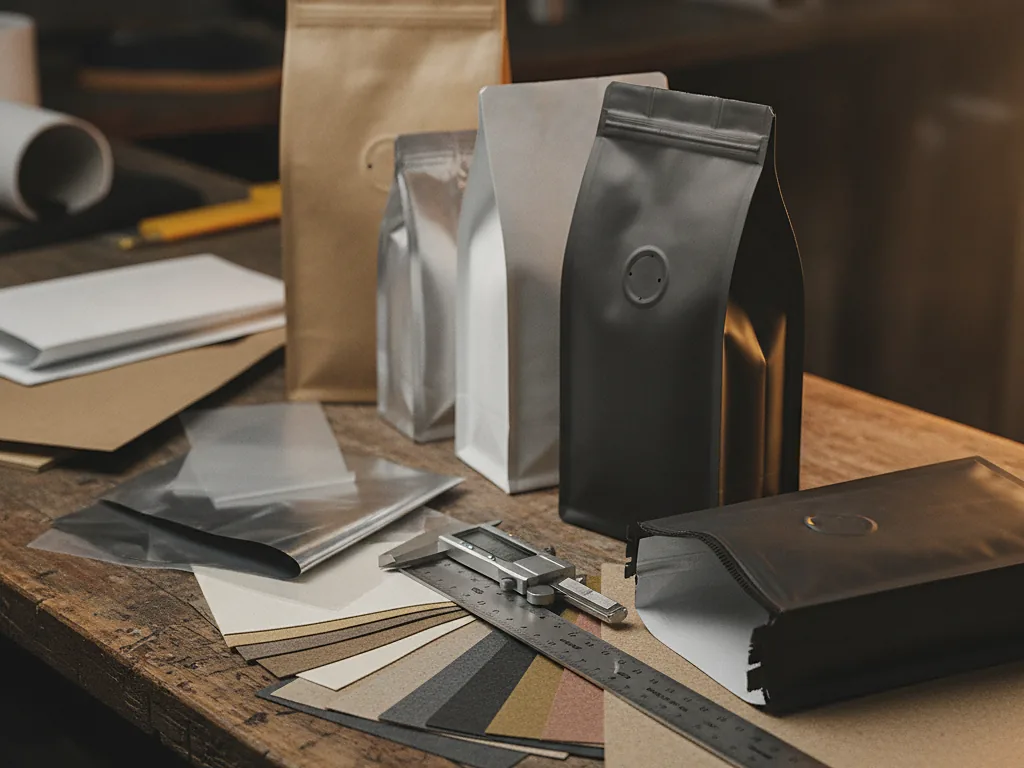
A custom coffee bag is a laminated pouch with a one-way degassing valve so fresh roasted beans can release carbon dioxide without letting oxygen in. The usual starting point is a 12 ounce flat bottom bag with a foil or metallized barrier and a zipper, then an 8 ounce for samples and a 2 pound for wholesale.
Why the valve is not optional
Roasted coffee releases carbon dioxide for days after roasting, and a 12 ounce bag of fresh beans can give off enough gas to balloon and split a sealed pouch. A one-way degassing valve lets that gas out and closes when the pressure drops, so oxygen does not get back in. Without a valve the roaster has to rest the beans for three to five days before bagging, which is time off the shelf and off the freshness date.
The valve is 3/4 in and goes on the front or back panel, above the print line so it does not cut through a logo. It sits under a small round of the laminate, which is why you see a dimple on most bags. The valve is heat sealed during the bag build, not stuck on afterward, so it does not leak at the edge.
Barrier structures compared
| Structure | Oxygen barrier | Look | Suits |
|---|---|---|---|
| Matte PET, aluminum foil, PE | Highest, near zero transmission | Any print outside, matte or soft-touch | Wholesale, long shelf life, dark roasts |
| Kraft paper, aluminum foil, PE | Highest | Natural kraft outside | Craft roasters who want the kraft look without losing barrier |
| Metallized PET, PE | High, a step below foil | Silver base under matte or gloss print | Retail 12 and 16 oz bags that sell within weeks |
| Kraft paper, PE (stand up pouch) | Low, days not months | Natural kraft, no shine | Coffee sold within the week at a cafe counter |
The first three are the films on our coffee bag with valve, all food-contact grade. We do not run a recyclable mono-PE coffee film, so if a recycling claim matters more to you than barrier, that is a different supplier. For more on what each layer does, see pouch material selection or the foil laminate material page.
The sizes a coffee lineup needs
Three sizes cover a typical coffee lineup. The 12 ounce is the retail standard. The 8 ounce, sometimes sold as 250 grams, is the sample and gift size. The 2 pound, or 5 pound for a few, is the wholesale bag for cafes. A 16 ounce exists, but many lineups go straight from 12 ounce to 2 pound.
Flat bottom bags stand square on a shelf and hold their shape as beans are used. Stand-up pouches with a rounded gusset are cheaper and lighter but slump when half empty. Side gusset bags with a tin tie are the traditional shape and still the cheapest to run, but they do not have a zipper and they do not stand well when full.
Typical dimensions
| Fill | Flat bottom (W x G x H, in) | Stand-up pouch (W x H, in) | Zipper |
|---|---|---|---|
| 8 oz | 3.5 x 2.5 x 8 | 5 x 8.5 | Yes |
| 12 oz | 4 x 2.5 x 9.5 | 6 x 9.5 | Yes |
| 16 oz | 4.5 x 3 x 10.5 | 7 x 10.5 | Yes |
| 2 lb | 6 x 3.5 x 12 | 8 x 13 | Yes or tin tie |
| 5 lb | 7.5 x 4 x 14 | Not suggested | Tin tie |
An illustrative spec: three single origins
Illustrative spec, not a client order.
Say a roaster is launching three single origins in a 12 ounce flat bottom bag, 200 bags of each, 600 in total, so every version meets the 200-unit minimum on the coffee bag with valve. We would spec a matte metallized PET/PE laminate, a 3/4 in valve on the back panel, and a pocket zipper below the tear notch. The print would be full color digital, one shared design with the origin name in a different color block on each version.
A bag of 4 by 2.5 by 9.5 inches holds 12 ounces of whole bean with about an inch of headspace above the zipper for the heat seal, which a bench impulse sealer handles. Expect 10 to 14 business days after proof approval, the lead time on the coffee bag with valve page. Food-contact documentation for the films is available on request and supplied with the quote. Keep the back panel clear for the roast date sticker and the weight statement.
What goes where on the bag
Front panel: name, origin, roast level, net weight. The net weight statement has rules on type size and placement that depend on the panel area, set out in 21 CFR 101.105, so we leave the bottom third of the front panel clear of anything that would fight it. Back panel: tasting notes, roast date area, valve. Gussets: a color or a pattern, since they are seen on the shelf edge on. Keep the tear notch and the zipper zone free of fine text, since the seal bar can distort print in that band. If the bags go on a retail shelf in a gift set, a printed coffee carton can hold the bag and carry the story.
Questions people ask
Can I order a bag with no valve for tea or drip bags?
Yes, and it is the right call for tea, ground coffee that has rested, and single serve drip pouches. The bag is otherwise the same. Ground coffee degasses far faster than whole bean, so if you grind to order and bag the same day, keep the valve.
How long does coffee stay fresh in a metallized bag?
With a valve, a zipper and a good heat seal, a metallized bag keeps whole bean fresh for weeks rather than days. A foil laminate stretches that further. A plain kraft and PE bag with no metallized layer is a bag for coffee sold within the week. Set your best-by date from your own cupping, since roast level and bean change it.
Do you print the roast date and weight?
The weight, yes, as fixed print if every bag holds the same fill. The roast date is a sticker or a stamp because it changes daily. We can supply matching sticker label sheets so the date label looks like part of the bag rather than something added at the counter.