What is SBS paperboard, and 18pt vs 24pt explained
SBS stands for solid bleached sulfate: paperboard made from bleached virgin wood pulp with a clay-coated face that prints bright and clean. The point number is thickness in thousandths of an inch, so 18pt is 0.018 inches and 24pt is 0.024. Use 18pt for most cartons and products under about 12 ounces, and 24pt for heavier products, including most glass over 100 ml, larger boxes and trays.
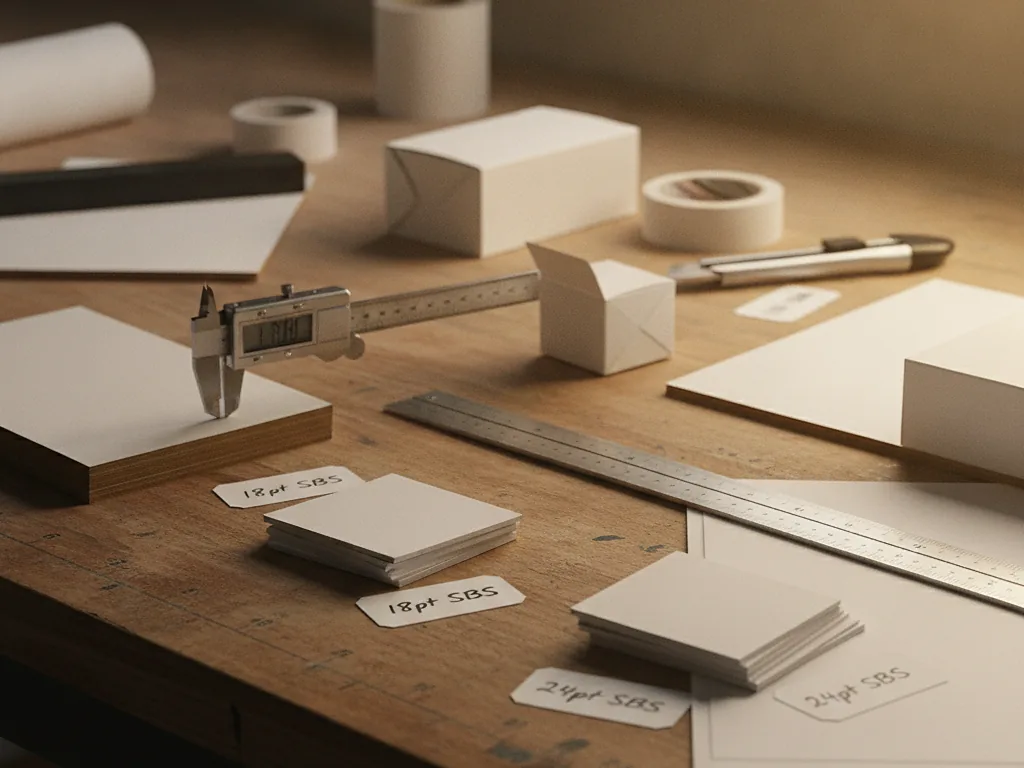
What SBS is and why cartons use it
Solid bleached sulfate is a single-ply board made from chemically pulped and bleached virgin fiber, then coated on one side with a clay layer for printing. Because the fiber is white all the way through, a cut edge looks clean and a crease does not show brown. The coated side takes offset and digital ink with sharp dots and true color, and it takes lamination, foil and spot UV without fuss. The back is usually uncoated, which is why the inside of a carton looks a little duller and why inside print needs a coated-two-sides board or a second pass.
The alternatives are CCNB, which is recycled board with a gray back and a coated face, and kraft, which is unbleached and brown. CCNB is common in the trade for cartons that ship inside something else, but it is not part of our range. Kraft is a look in its own right, and we run it on cartons such as the coffee carton. For anything that stands on a shelf under shop lighting, SBS is what we reach for.
What the point number means
Board caliper is measured in points, and one point is one thousandth of an inch. So 14pt is 0.014 inches, 18pt is 0.018 inches and 24pt is 0.024 inches. Stiffness rises faster than thickness, roughly with the cube, which is why 24pt feels far more than a third stiffer than 18pt in the hand. Weight rises too: 18pt SBS runs close to 300 gsm and 24pt close to 400 gsm, and that shows up in freight on a large order.
Points are not the same as pounds, which is the other number you will see on paper. Cover stock sold by weight, like 100 lb cover, is roughly 14pt and is a paper, not a board. It is fine for a hang tag and too light for a carton. When a supplier quotes you a board in gsm rather than points, ask for the caliper as well, because two boards at the same weight can differ in thickness by a fifth depending on how densely they are made.
Calipers in use
| Caliper | Inches | Where we use it |
|---|---|---|
| 16pt | 0.016 | Small cartons such as the lip balm carton |
| 18pt | 0.018 | Most cartons under 5 inches a side, sleeves, belly bands |
| 20pt | 0.020 | Lock bottom and candle cartons, supplement cartons for glass over 4 ounces, cake boxes |
| 24pt | 0.024 | Products over about 12 ounces, sleeve and tray cartons, boxes over 5 inches |
Where 18pt stops and 24pt starts
18pt is the working standard because it folds cleanly, glues well, runs on every carton press and holds a carton up to about 5 inches on its longest side without bowing. A 30 ml dropper, a 50 ml jar, a lip balm, a bar of soap, a candle under 12 ounces: all 18pt. It is also the board that takes soft-touch and foil best, because the surface is smooth and the sheet lies flat under the laminator.
Move to 24pt when the product is heavy for its size, when the filled product passes about 12 ounces, which takes in most glass over 100 ml, when any panel is over 5 inches, or when the box has to hold its shape without the product inside it. A sleeve and tray carton runs on 24pt. A 200 ml jar in a straight tuck end, such as our cream jar boxes, is 24pt. A carton that will be stacked six high on a pallet is 24pt. The cost of the board goes up, the crease needs a wider channel, and the tuck flaps need slightly more clearance, and we handle all of that on the dieline.
An illustrative spec: two cartons that match
Illustrative spec, not a client order.
Say a skincare brand has two products: a 30 ml serum in a 1.5 inch square glass bottle, and a 200 ml body cream in a 3 inch round jar that weighs nearly a pound full, and wants the two cartons to match. We would run the serum carton at 1.75 by 1.75 by 4.5 inches on 18pt with soft-touch, and the cream carton at 3.125 by 3.125 by 3.5 inches on 24pt with the same soft-touch film and the same foil logo. Side by side on a shelf the board difference does not show. In the hand, the cream carton does not flex under the jar, which is the whole point.
At 250 units each, the 24pt carton needs its own cutting die because of the wider crease, and both ship flat, 10 to 14 business days after proof approval for a straight tuck end carton.
Questions people ask
Is SBS recyclable?
Plain SBS with an aqueous coating is recyclable as mixed paper. Once it is laminated with a plastic film the answer depends on the local facility, and we do not print a recycling claim on a laminated carton without checking. Foil stamping and spot UV on their own do not usually prevent recycling.
Is SBS food safe?
Virgin SBS is the board used for most direct-contact food cartons in the US. Food-contact grades are available for bakery and chocolate work, with documentation available on request and supplied with the quote. Recycled board is not normally used for direct contact, so for anything that touches food we specify a food-contact grade and say so on the quote.
Can I get 18pt printed on both sides?
Yes. Standard SBS is coated one side, so inside print on it looks slightly softer. For a carton where the inside is part of the design, ask about a board coated on both sides; we confirm on the quote whether it is available for your size, and it costs a little more per sheet.