Skincare packaging: cartons, inserts and the claims you can print
Skincare usually ships in a straight tuck end carton on 18pt SBS, moving to 24pt once the filled product passes about 12 ounces, which takes in most glass over 100 ml, with a paperboard cradle if the bottle is glass. The back panel carries the identity, net contents, ingredients in descending order and the responsible party. Print cosmetic claims freely. A claim to treat or prevent a condition makes it a drug.
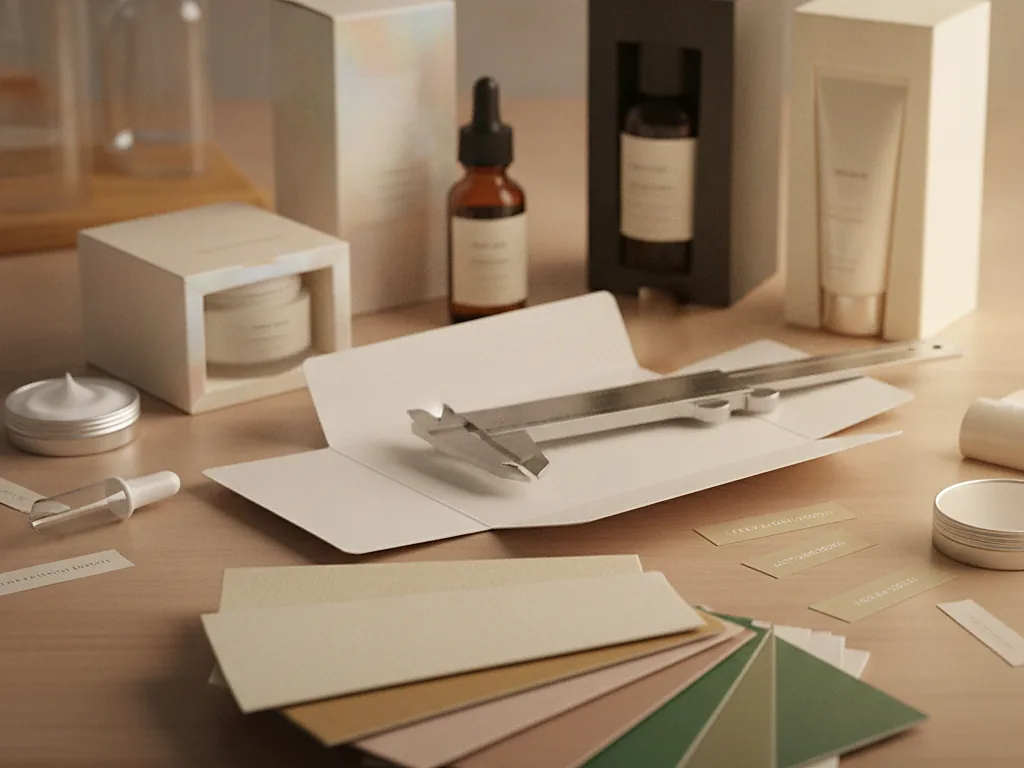
The carton and the board
A skincare carton is almost always a straight tuck end, because it stands upright on a shelf, opens from the top and closes again without tearing. 18pt SBS is the standard board for a 30 ml dropper, a 50 ml pump or a 50 ml jar. Once the filled product passes about 12 ounces, which takes in most glass over 100 ml, we move to 24pt so the panels do not bow under it. Soft-touch lamination is a common choice for premium skincare, and matte aqueous is the practical choice for a sample size or a carton that ships inside a mailer.
Tubes are the exception. An aluminum or plastic tube with a flip cap is light and does not need a cradle, but it needs a carton sized to the cap end, not the crimped end, and a reverse tuck so the tube can be slid in cap-first and sit level. We draw those on the dieline with the cap dimension as the width.
Sizes for the common formats
| Product | Container | Carton inside, inches | Board | Insert |
|---|---|---|---|---|
| 30 ml serum | 1.5 in square dropper, 4.25 tall | 1.75 by 1.75 by 4.5 | 18pt | Collar |
| 50 ml pump | 1.75 in round, 4.75 tall | 2 by 2 by 5 | 18pt | Cradle |
| 50 ml jar | 2.5 in round, 2 tall | 2.75 by 2.75 by 2.25 | 18pt; see cream jar boxes | None or cradle |
| 100 ml lotion | 2 in round, 5.5 tall | 2.25 by 2.25 by 5.75 | 18pt | Cradle |
| 200 ml cream jar | 3.25 in round, 3 tall | 3.5 by 3.5 by 3.25 | 24pt | Cradle |
| 100 ml tube | 1.5 in cap, 6 tall | 1.75 by 1.25 by 6.25 | 18pt | None |
The insert that stops the rattle
Glass in a carton needs something to hold it, or it knocks against the walls in transit and the customer hears it before they see it. A paperboard collar is a die-cut ring glued into the base of the carton that the bottle sits in. A cradle is a folded platform that holds the bottle off the base and grips it at the shoulder. Both are cut from the same 18pt SBS as the carton, glued in on the gluer, and add nothing to the lead time. A collar suits a dropper, which is how our serum dropper carton is built. A cradle suits a pump or a lotion bottle that is taller than it is wide.
For a set of three or four products in one box, the carton becomes a rigid box, such as our skincare set box, with a multi-cavity paperboard or foam insert, each cavity cut to its bottle with an eighth of an inch of clearance. That is rigid box work, and a physical prototype, available on request with timing confirmed in the quote, is where you check the fit before anything is printed. Send us the bottles rather than the drawings for that one.
What has to be on the box
Under the FDA cosmetic labeling rules, a US cosmetic carton has to carry the product identity, the net contents in both fluid ounces and milliliters on the principal display panel, the ingredient list in descending order of predominance, and the name and address of the manufacturer, packer or distributor. Warnings go on the carton where the product needs them. The ingredient list is the panel that runs out of room, so we set it at 6 point minimum in a condensed face on the back and check on the proof that nothing has crossed the safe area. We lay all of this out for you on the dieline; the wording is yours and your regulatory adviser's. This is packaging guidance, not legal advice.
Leave a clear area on the base or back for a batch code and a best-by date or period-after-opening symbol, and tell us whether you will stamp or label it, so the surface underneath is left plain. A soft-touch film takes an inkjet batch code badly, so if you code at filling, we leave that area unlaminated or you use a label.
Claims: cosmetic, drug and the ones with no definition
A cosmetic claim describes what the product does to the appearance of skin: moisturizes, smooths, brightens the look of, reduces the appearance of fine lines. Those print without a problem. A drug claim says the product affects the structure or function of the body or treats a condition: treats acne, heals eczema, repairs DNA, reduces inflammation, protects from the sun with an SPF. Any one of those makes the product a drug in the eyes of the FDA, as its guide Is it a cosmetic, a drug, or both? explains, with its own labeling rules, so have that wording reviewed before artwork goes to proof; we reserve the panel space but don't review claims. The line is the verb, so a useful rule of thumb is that anything you could say about make-up is safe.
Then there are the words with no legal definition: natural, clean, non-toxic, dermatologist tested, hypoallergenic. You can print them, but you should be able to back them if asked. Organic has a definition under the USDA, and cruelty-free has certification schemes with their own logos and license terms. We do not check those claims; we just make sure there is room for the logos and that they sit inside the safe area.
An illustrative spec: a three-product launch
Illustrative spec, not a client order.
Say a launch has three products: a 30 ml serum, a 50 ml moisturizer in a pump and a 50 ml jar of night cream, 250 cartons each. We would run all three on 18pt SBS with soft-touch and a champagne foil logo, the same front layout with the product name changed, and a shared back panel structure with the ingredient list set at 6.5 point. The serum gets a collar, the pump gets a cradle, and the jar needs nothing because it fills the carton.
Three dielines, one artwork template, one proof round, and the whole set ships flat, 10 to 14 business days after proof for a straight tuck end carton. If a claim like "repairs the skin barrier" is on the front panel, we flag it on the proof, and it usually belongs on the website in softer wording. The box is the most permanent place a claim can live, so it is the place to be most careful with the verb.
Questions people ask
Do you print the ingredient list for us?
We set it on the back panel from the text you supply, in descending order as you give it, and we check the type size and the safe area. We do not check INCI names or the order, because that is a formulation question. Send the list as plain text, not as an image, so it stays sharp.
Can the carton have a window to show the bottle?
Yes, a die-cut window with a clear film patch, and it works well for a colored serum or a jar with a visible texture. The window is cut on the same die and the film is glued in on the gluer, so there is no extra lead time. Keep the window inside the safe area and away from creases.
Does the SPF product need a different carton?
The carton can be the same structure and board. The labeling cannot, because a sunscreen is an over-the-counter drug in the US and carries a Drug Facts panel in a prescribed format that takes most of the back and one side. Tell us it is an SPF product when you order and we lay out the panel to fit.