Foil stamping vs spot UV vs embossing: effect, and which reads as premium
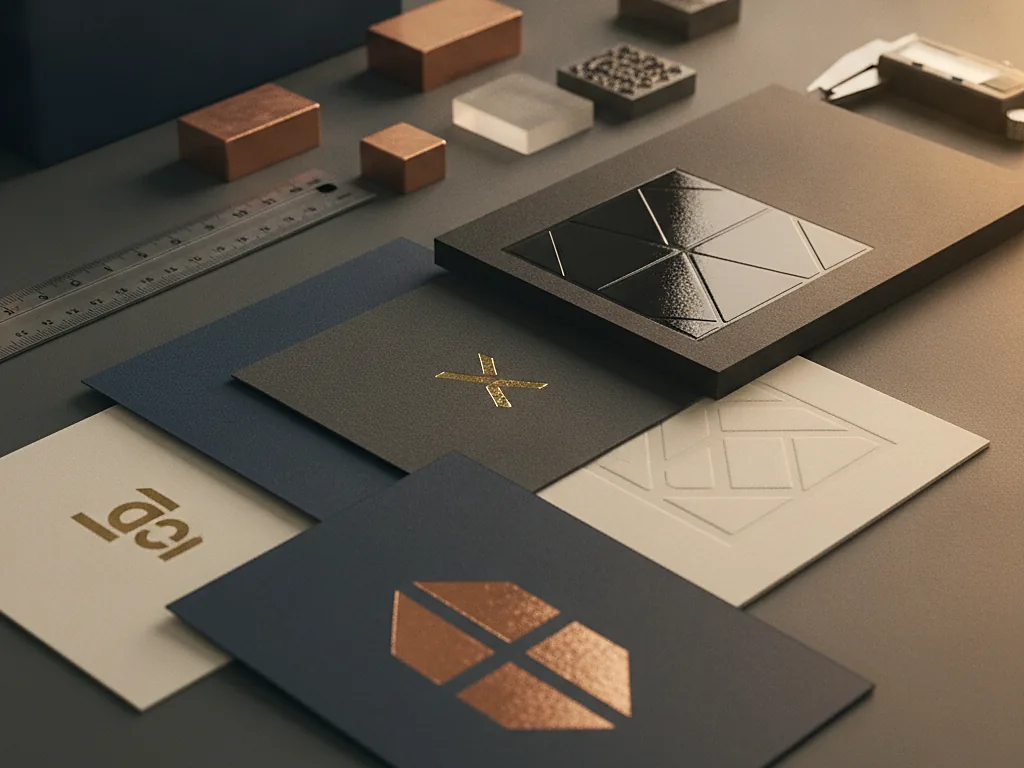
Foil adds a metallic or pigment film pressed with a heated die. Spot UV adds a clear gloss layer over chosen areas of a matte surface. Embossing raises the board, debossing sinks it. Blind deboss on a matte wrap reads as the most premium of the three because it is felt before it is seen. Foil works used once, small.
What each finish actually does
Foil stamping presses a thin film onto the surface with a heated brass or magnesium die. The film can be metallic, a flat pigment, or holographic. It sits on top of the print and catches light. Spot UV is a clear varnish cured under ultraviolet light, applied only where the artwork says, so a matte surface gets glossy islands. Embossing and debossing use a pair of dies to push the board up or down, with no ink and no film, so the effect is pure shadow. The three can stack. Registered foil over a deboss, called combination stamping, is one pass with one die and a common choice on fragrance and spirits boxes.
Side by side
| Foil stamping | Spot UV | Emboss or deboss | |
|---|---|---|---|
| Works on | Rigid wrap, 18 to 24pt SBS, kraft | Laminated or coated SBS only | Rigid wrap, 24pt SBS, thick kraft |
| Minimum line weight | About 0.5 pt, fine serifs fill in | About 0.75 pt | About 1 pt, 2 pt for deep deboss |
| Tooling | Brass die, reusable | Screen or plate, cheap | Male and female dies, reusable |
| Reads on camera | Strongly, flashes | Only when tilted | Only in low, side light |
| Reads in the hand | Slightly, film is smooth | Yes, gloss over matte | Yes, immediately |
Which one reads as premium
It is almost always the one used with restraint. A single blind deboss of a logo on a soft-touch wrap on 1200 gsm grayboard is the finish people read as expensive without being able to say why. Their thumb finds it before their eye does. A large foil panel reads as a cosmetic gift set from a chain store. A small champagne foil mark, under an inch, on a matte navy wrap reads as a jeweler. Restraint is the whole trick, and it is the hardest thing to hold on to at proof stage.
Spot UV is the outlier. It photographs poorly, since it only shows at an angle, and it is the cheapest of the three, which buyers have learned to recognize. It works well as a texture play, a gloss pattern across a whole matte carton, and less well as a logo treatment on its own. Where it earns its place is on a carton run where the budget does not stretch to a die.
What the board has to be
Embossing needs thickness to hold the shape. On 18pt SBS a deboss is shallow and the reverse side shows the mark, which matters on a carton with an unprinted inside. On 24pt it holds. On a rigid box the wrap is thin but the grayboard underneath takes the impression, so deboss depth of about 0.012 in is easy and 0.02 in is possible on 1500 gsm. Ask for a sample of the board with a deboss on it before committing; the depth on paper and the depth in the hand are different things.
Foil goes on almost anything, but it lifts on soft-touch lamination unless the foil goes down first and the soft-touch is applied over it, which changes the sequence; the quote confirms any effect on timing. Spot UV needs a coated or laminated surface. On uncoated kraft it soaks in and looks like a wet patch. Matte aqueous coating takes spot UV well and keeps the carton recyclable.
An illustrative spec: two touches on a fragrance box
Illustrative spec, not a client order.
Say a 100 ml fragrance goes in a 4.5 by 4.5 by 6.5 inch magnetic closure box on 1200 gsm board, 300 units, and the brand has a wordmark and a small monogram. We would put the monogram as a registered champagne foil over deboss on the lid, 0.9 inches wide, and the wordmark as a blind deboss on the front edge at 2.2 inches wide, on a matte black art paper wrap. No spot UV.
Tooling is one combination die and one deboss die, both kept on file for a reorder. Expect 12 to 14 business days after proof, the magnetic closure box lead time. A physical prototype to check the monogram position against the bottle is available on request, with timing confirmed in the quote. Two touches and nothing else is the point.
Cartons get the same choices, with limits
On an 18pt straight tuck end carton the honest options are foil and spot UV. Deboss is possible but shallow. If the carton is soft-touch laminated, foil should be planned from the start so it goes under the film. If the carton is matte aqueous coated, spot UV over the coating gives a clean contrast and costs the least of the three. For a short run of a few hundred cartons we generally suggest foil or spot UV, not both, since two finishes on a small carton fight each other.
Questions people ask
Can foil be any color?
Most colors, yes. Gold, silver, copper, rose gold and champagne are standard. Flat pigment foils in white, black and common colors are standard too. A custom matched foil is possible but adds time and a minimum roll, so we usually suggest picking the closest standard foil and matching the print to it.
Does embossing weaken the box?
Not on rigid board, since the wrap is embossed before it is glued down and the grayboard underneath is not creased. On a carton, a deep emboss across a fold line can crack the board, so we keep embossed areas at least a quarter inch from any crease.
Which finish is recyclable?
Blind emboss and deboss add nothing to the board, so the box recycles as mixed paper. Spot UV is a thin varnish and is generally accepted in mixed paper. Foil is a small area of film and is accepted by most programs at the sizes used on a logo, but a full foil panel is not.