Paper tube sizing: inner diameter, wall, length and lids
A custom paper tube is defined by three numbers: inner diameter, wall thickness and body length. Size the inner diameter to the widest part of the product plus about 1/8 inch per side, choose a wall from about 0.04 inch for a lip balm push-up to 0.12 inch for a rigid gift tube, and measure length on the body without the lid. The lid or cap style then follows from how the product is used.
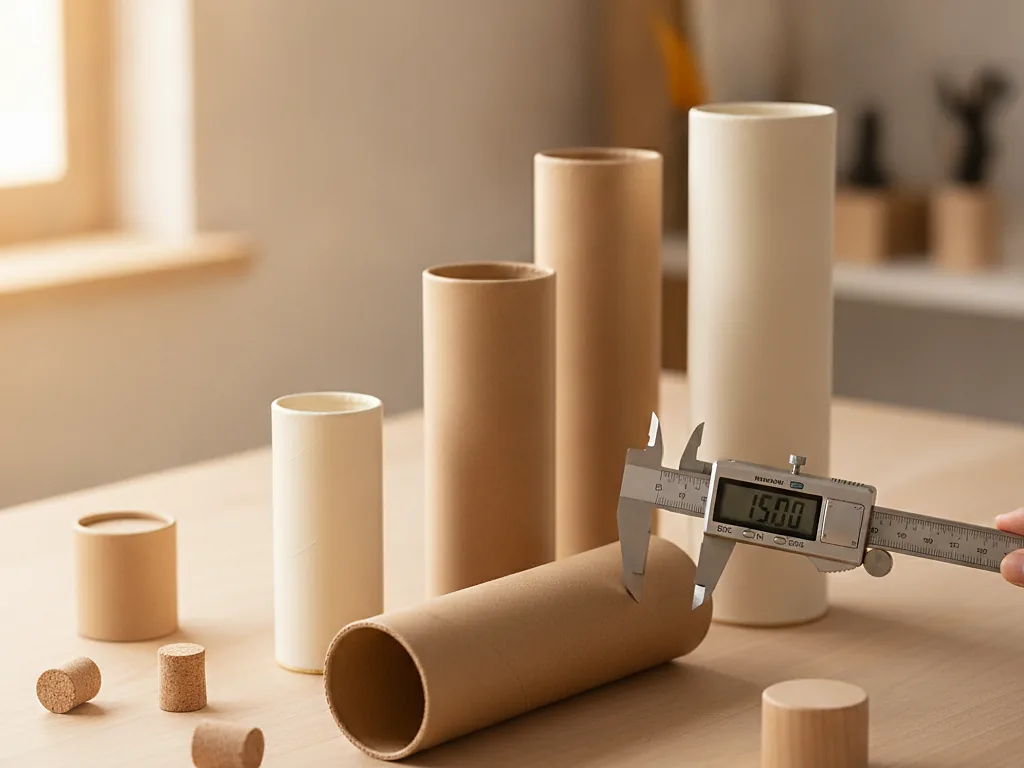
Inner diameter
Inner diameter, or ID, is the clear opening across the inside of the tube. It has to let the product slide in and out without forcing, but not leave it loose enough to rattle. Measure the widest part of the product, including any label or wrap, and add about 1/8 inch per side, so a 2 inch wide product goes in a tube with an ID of about 2.25 inches. A glass jar in a tube also needs a collar or an insert, which adds to the ID; tell us the jar size and we size both.
Our paper tube with lid runs from 1 inch to 5 inches in diameter. The 2 by 4 inch and 3 by 5 inch sizes suit most cosmetics, tea and gifts.
Wall thickness
The wall is spiral wound paperboard, and all of its thickness goes to the outside, so a thicker wall raises the outside diameter without changing the ID. That matters when the tube has to fit a display slot, a shipper or a carrier rate band.
| Wall | Feel | Where we use it |
|---|---|---|
| 0.04 to 0.06 in | Light, slightly flexible | Push-up tubes for lip balm and deodorant, pre-roll tubes |
| 0.06 to 0.08 in | Firm, resists denting | Paper tubes with lids for tea and cosmetics, shipping tubes |
| 0.08 to 0.12 in | Rigid, real weight in the hand | Candle tubes, telescoping tubes for spirits and gifts |
Heavier walls also hold a deboss and foil better, because the surface does not flex under the die.
Length
Length is the tube body, not the assembled tube. A body of 4 inches with a slip-on lid that adds a little height above it is still ordered as a 4 inch body; the lid depth, 0.75 to 1.5 inches on our paper tube with lid, is confirmed in the quote. Tubes that are very long relative to their diameter are hard to grip and hard to empty, and they look spindly on a shelf. For a tall bottle, a telescoping tube, where the lid slides the full depth of the base, handles the proportion better. For rolled posters and prints, a shipping tube runs 12 to 48 inches long.
Lids, caps and ends
Slip-on lid. A short tube of slightly larger diameter that sleeves over the body. The standard on our paper tube with lid, quick to open and reclose, no hardware. It can be all paper or have a metal end.
Full-depth telescoping lid. The lid slides over the whole base, so the closed tube shows one clean printed surface with a fine seam. Twice the board, and the feel of a rigid box.
Metal or tinplate ends. A tinplate bottom and metal slip lid, as on our tea tin style tube, make a paper tube look and close like a tin. Shipping tubes use crimped metal or glued paperboard plugs at each end.
Push disc. A push-up tube has a paperboard disc inside that the user pushes up from the base to advance a solid stick, with a slip cap on top and no plastic parts.
Child resistant cap. Our pre-roll tube takes a push-and-turn cap tested to 16 CFR 1700.20. It is the only child resistant closure in our tube range; the pre-roll tube guide covers that format in detail.
Putting it together
A useful starting spec looks like this: ID 2.25 inches, wall 0.08 inch, body length 5 inches, slip-on lid. From that you can work out the outside diameter, the ID plus twice the wall, or about 2.4 inches, and the size of the carton the tubes ship in. The free paper tube dieline shows how the wrap lays flat for print, and the Tria Studio shows the finished outside profile for any size you enter.
Questions people ask
How do I measure the right inner diameter for my product?
Measure the widest part of the product with any label or wrap on, then add about 1/8 inch per side. A product 2 inches wide needs an ID of about 2.25 inches. A glass jar that needs a collar needs more; send us the jar size.
What wall thickness should I choose?
Match it to the job. About 0.04 to 0.06 inch for push-up and pre-roll tubes, 0.06 to 0.08 inch for everyday tubes with lids, and 0.08 to 0.12 inch for candle, spirits and gift tubes that need to feel rigid.
What sizes do you make?
Our paper tube with lid runs from 1 inch to 5 inches in diameter, in kraft or white board, from 200 units in 10 to 14 business days after proof. Shipping tubes come in 2, 3 and 4 inch diameters and 12 to 48 inch lengths.
Can paper tubes hold heavy products?
Within reason, yes. A candle tube on 0.08 to 0.12 inch board holds a glass jar with a die-cut collar. For heavy items, a tinplate end adds rigidity at the base.
Paper tube or pre-roll tube: which guide do I need?
This guide covers sizing for any paper tube: cosmetics, tea, candles, gifts and shipping. If you are packaging pre-rolls or vape cartridges, read our pre-roll tube guide, which covers the slim 0.75 by 4.5 inch format, child resistant caps and state labeling.