Child resistant mylar bags: what the rules require and how to stay inside them
A child resistant mylar bag has a press zipper tested to the 16 CFR 1700.20 protocol, so young children cannot open it and adults can. State cannabis rules add opaque film, a resealable closure for multi-serving products and panel space for warnings. We produce them from 200 units; the zipper test documentation is available on request and supplied with the quote. This is packaging guidance, not legal advice.
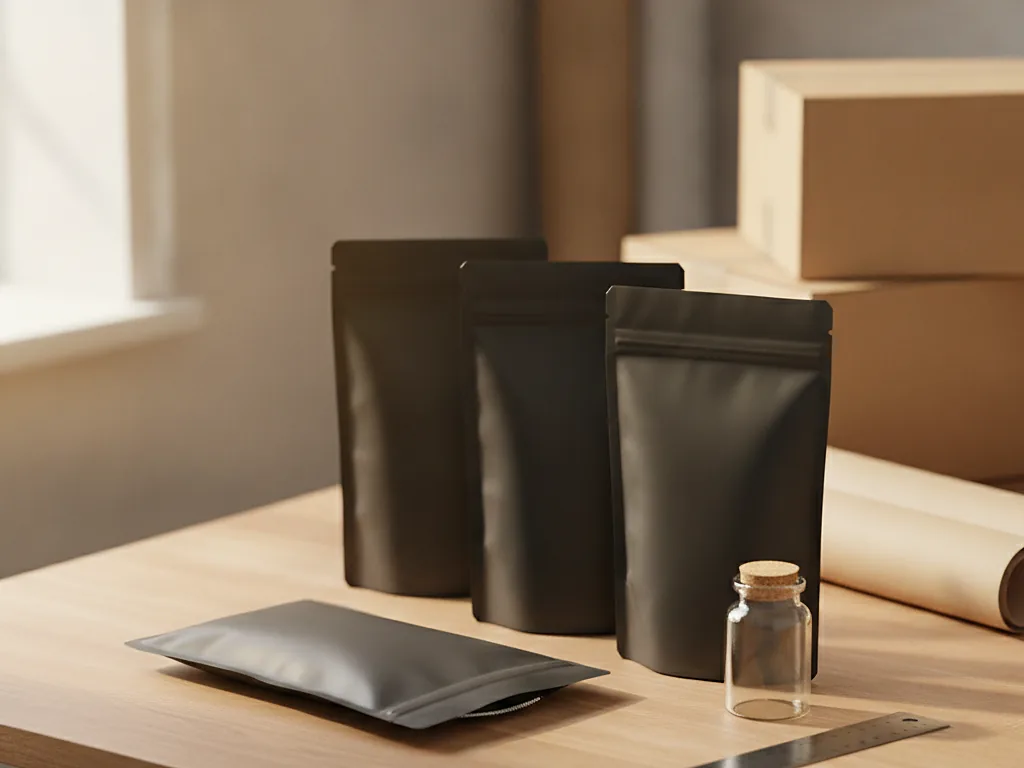
What child resistant actually means
Child resistant is a tested property, not a design style. The federal protocol, 16 CFR 1700.20, was written for medicine bottles under the Poison Prevention Packaging Act and has been adopted by nearly every state cannabis program for consumer packaging. In the test, panels of children aged 42 to 51 months are given the package and a few minutes to open it, first without and then with a demonstration, and panels of adults aged 50 to 70 are timed opening it and closing it again. The package passes when most of the children fail and nearly all of the adults succeed. To pass, the package needs at least 85% child-resistant effectiveness before the demonstration, 80% after it, and at least 90% senior-adult effectiveness.
For a bag, the tested part is the zipper. A child resistant zipper has to be pinched at a marked point and pulled at the same time, which small hands cannot coordinate. The print does not affect certification. The zipper, the film it is sealed into and the tested size range do. The test documentation, available on request with the quote, names that zipper and film.
What the states add
Federal child resistance is the floor. State cannabis rules, and increasingly state hemp rules, build on it. Many require opaque packaging, at least for edibles, which rules out a window there. California, for example, requires it for edibles but not flower. Most require the closure to be resealable and child resistant after every opening if the package holds more than one serving of an edible, which is why a press zipper rather than a heat-seal-only bag. Most require a universal symbol at a minimum size, a warning statement in a minimum type size and a clear area for a label with batch, potency and testing information. The wording and the symbol differ by state, and some states change them yearly.
We handle the structure on our child resistant mylar bag: the tested child resistant zipper, the opaque laminate, the tear notch, and the panels reserved on the dieline for the symbol, the warning and the label. The text and the symbol file come from you and your compliance adviser, and we place them where you tell us without editing them. If a state changes its wording between your first run and your reorder, the dieline stays the same and only the text in the reserved panel moves. Your state regulator publishes the current rules; in California that is the Department of Cannabis Control.
Sizes that get ordered
| Holds | Bag size, inches | Style | Typical use |
|---|---|---|---|
| 1 gram | 2.5 by 3.5 | Three side seal, CR zipper | Pre-roll, concentrate |
| 3.5 grams | 3.6 by 5 | Three side seal, CR zipper | Flower, eighth |
| 7 grams | 4 by 6.5 | Stand-up, CR zipper | Flower, quarter |
| 14 grams | 5 by 8.2 | Stand-up, CR zipper | Flower, half |
| 28 grams | 6 by 9.2 | Stand-up, CR zipper | Flower, ounce |
| Edibles, 100 mg | 4 by 6.5 | Stand-up, CR zipper | Gummies, ten servings |
Film, barrier and print
The film is a metallized barrier laminate, usually three layers: a printed outer PET, a metallized barrier layer and a heat-sealable inner PE. Total thickness runs around 4 to 5 mil. The metallized layer is what makes the bag opaque, and it cuts oxygen, moisture and odor transfer well. It reduces odor; it does not stop it. The true odor barrier is a foil laminate, PET over aluminum foil over PE, which is what the smell proof mylar bag is built on. An opaque bag and a smell proof bag are not automatically the same bag, and no bag holds odor once it has been opened and resealed a few times, so we do not promise it. Where a state allows a window, a clear PET patch is laminated in and the barrier is slightly lower across it. We print digitally in CMYK with a white underprint over the metallized surface, matte or gloss, so a small run of 200 gets the same print quality as 5,000.
Bags are supplied flat and open at the top, heat-sealed by you after filling with a hand sealer or a band sealer. The tear notch sits above the zipper so the first opening breaks the seal and every opening after that uses the zipper. For flower, a stand-up bag with a bottom gusset holds its shape on a dispensary shelf; for pre-rolls and concentrates, a flat three side seal bag is cheaper to fill and stacks in a drawer. Single pre-rolls often go in a pre-roll tube instead, and gummies can go in our gummy pouches, which take a child resistant zipper on request; check your state on opacity first. For a shaped bag, die-cut mylar bags start at 1,000 units.
An illustrative spec: an eighth in an opaque state
Illustrative spec, not a client order.
Say a licensed brand in a state that requires opaque packaging needs 500 bags for 3.5 gram flower. We would spec them at 3.6 by 5 inches, three side seal with a tested child resistant zipper and a tear notch, matte black with a white underprint and a single spot of color for the strain name. The front carried the brand and a 1.5 inch reserved square for the state symbol at its minimum size. The back carried the warning statement at 8 point, set from the state's wording as supplied, and a 2 by 1.5 inch clear area for the dispensary's compliance label. Nothing printed inside the reserved areas.
Now say the same brand wants to reuse the artwork for a hemp product sold in another state. The structure carries over. The panel contents do not, because that state uses a different symbol and different wording, so the reserved areas stay where they are and only the artwork inside them changes. That is the point of reserving space rather than designing around a specific state's text.
Questions people ask
Do I need a certificate for each bag design?
No. The test documentation covers the zipper and film combination, not the artwork or the size within the tested range. It is available on request and supplied with the quote, and it names the tested structure. If you change to a different zipper or a windowed film, the documentation changes, so tell us if a reorder is not identical.
Can a child resistant bag also be an exit bag?
Yes, a larger child resistant bag, usually 8 by 12 inches or 9 by 12, with the same zipper, is the exit bag a dispensary puts the purchase in at the counter. Some states, including California, no longer let an exit bag stand in for child-resistant product packaging. It is printed with the dispensary's brand rather than a product brand, is usually opaque, and is ordered in the same way from 200 units.
Is a heat seal alone child resistant?
Not on its own. A plain heat seal is not child resistant unless the package has been tested, or a state rule accepts it. California, for example, accepts 4 mil heat-sealed plastic with no easy-open tab for single-serving or single-use packages. Some states treat a single-serving, tear-open package differently from a resealable one, but that is a state rule and it varies. For anything resealable or holding more than one serving, order the tested child resistant zipper and do not rely on the seal.